
AUSTRALIA STATE NOMINATION 2025–26: A TIGHTER PROGRAM, A FASTER CYCLE, AND A CLEAR OFFSHORE SHIFT
Englingua – Australia Skilled Migration Specialist | CAANWINGS Consultants
Australia’s skilled migration roadmap has entered a decisive new phase—and the implications for offshore professionals are profound. With the 2024–25 state nomination allocations released on 18 July 2024, followed by the 2025–26 allocations announced on 18 November 2025, the entire migration cycle now operates under a compressed 6–7-month window. This is a structural shift that demands faster decision-making, tighter documentation, and state-specific precision.
At Englingua / CAANWINGS, we’ve distilled the latest allocation changes into clear, actionable insights to help skilled professionals position themselves for success in one of the most competitive migration years in recent history.
- The Time Compression: Only 6–7 Months for States to Nominate
This year, the states and territories are not working with a full program-year runway.
By receiving allocations late in the cycle, they must now:
- Open their programs mid-year
- Conduct rapid nomination rounds
- Close early once quotas are exhausted
The result is a high-velocity nomination environment where only well-prepared applicants will be shortlisted. Englingua’s advisory framework is designed specifically to help clients move at this pace through rapid EOI updates, occupation targeting, and pre-emptive documentation.
- The 190 vs 491 Divide: Where States Are Truly Investing
A clear structural shift is now visible across the country:
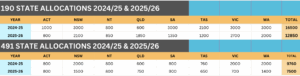
Permanent Residency (Subclass 190)
Reduced across several states, with priority going to:
- Health & Allied Health
- Education & Early Childhood
- Construction & Infrastructure
- MLTSSL occupations
- Onshore applicants with workforce attachment
States are ring-fencing their limited 190 places for job-ready talent already contributing to their economy.
Regional Pathway (Subclass 491)
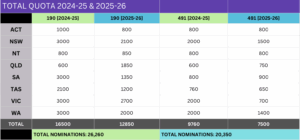
Stable quotas, minimal reductions, and strong offshore accessibility.
This visa pathway remains the fastest-growing opportunity for offshore applicants in 2025–26.
Englingua’s offshore strategic planning now places the 491 visa as a primary entry channel for many skilled professionals targeting long-term settlement.
- State-by-State Allocations: Increases, Reductions & What They Signal
Englingua’s migration analytics team has broken down the 2025–26 shifts across each jurisdiction:
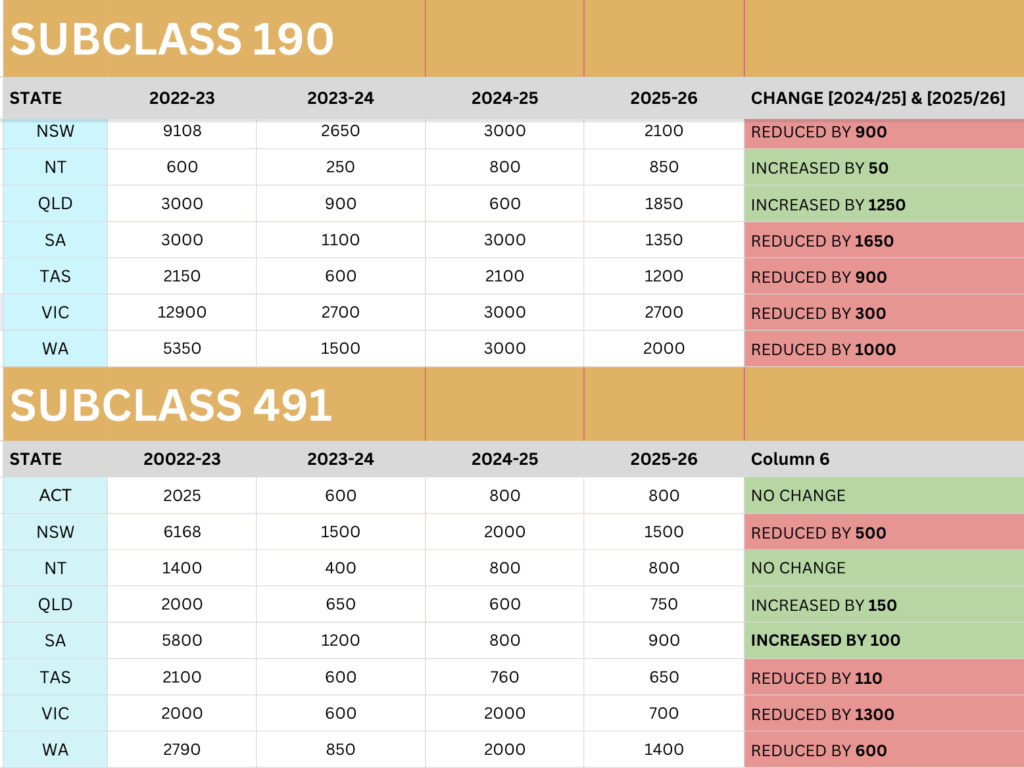
ACT – No Change
Steady quotas, consistent selection patterns.
Opportunities remain open for aligned occupations under the ACT Matrix.
Englingua Insight: Ideal for specialised professionals with niche skills.
NSW – Reduced by 500 (Approx. 25% Cut)
The biggest volume contraction among major states.
Reduced time + reduced quota = higher competition.
Englingua Insight: Offshore candidates must target priority shortages only.
Northern Territory – No Change
Large occupation list sustained.
Strong 491 accessibility.
Englingua Insight: Excellent offshore pathway for applicants comfortable with regional settlement.
Queensland – Increased by 150
Clear demand growth in trades, hospitality, health, and regional services.
Englingua Insight: One of the strongest 491 growth markets this year.
South Australia – Increased by 100
Expanded occupation list.
Sustained offshore openings.
Englingua Insight: SA remains one of the top three offshore-friendly states.
Tasmania – Reduced by 110
Conservative approach to offshore nominations.
Stronger focus on onshore connections and employability.
Englingua Insight: Selective but viable for candidates with industry-aligned experience.
Victoria – Reduced by 1,300
One of the sharpest statewide reductions.
Very conservative offshore nomination strategy.
Strong prioritisation of MLTSSL and high-demand sectors.
Englingua Insight: VIC is possible—but only for top-tier profiles with exceptional credentials.
Western Australia – Reduced by 600
Many offshore applicants do not meet WA’s extra requirements.
491 remains viable but selective.
Englingua Insight: Applicants must meet WA-specific criteria, not just ANZSCO standards.
- The 491 Advantage: Stability & Offshore Opportunity
While the 190 allocations have tightened significantly, 491 quotas have remained stable in most states.
This is by design.
States know that:
- Regional areas face chronic skill shortages
- Offshore talent is essential
- The 491 provides a controlled pathway to long-term settlement
Englingua’s offshore strategy now leverages this stability to secure faster outcomes for clients positioned for regional growth.
- The 189 Absorption Effect: Zero Wastage, Higher Selectivity
The Skilled Independent (Subclass 189) program has absorbed part of the high-value applicant base, ensuring no wastage in the 190 and 491 categories.
This means:
- States will nominate only the strongest, most aligned profiles
- Expect sharper cutoff points and fewer generalist occupations
- DHA is pushing toward a fully optimised skilled migration pipeline
Conclusion: A High-Velocity, High-Precision Migration Year
The 2025–26 cycle demands a fundamentally different approach.
This is a year for:
- Faster decision-making
- Targeted state selection
- High-documentation readiness
- 491-centric offshore planning
- Precision alignment with occupation lists
At Englingua / CAANWINGS, we are already recalibrating profiles, updating EOIs, and advising clients on strategic pivot pathways that maximise nomination chances under the new model.
This is not the year to apply late. This is the year to apply smart.